ScholarAI Review 2026: The AI Research Assistant Transforming Academic Research, Literature Reviews, and Scientific Writing
ScholarAI Review: Research has always been one of the most time-consuming aspects of academic and professional work. Whether you’re a student writing a dissertation, a researcher conducting a literature review, or a professional analyzing scientific publications, finding relevant information often requires hours of searching, reading, comparing sources, and organizing notes.
The challenge has become even greater as the volume of published research continues to grow.
Every day, thousands of new papers, studies, patents, and academic publications are released across multiple disciplines. Keeping up with this information can feel impossible.
This is where ScholarAI aims to help.
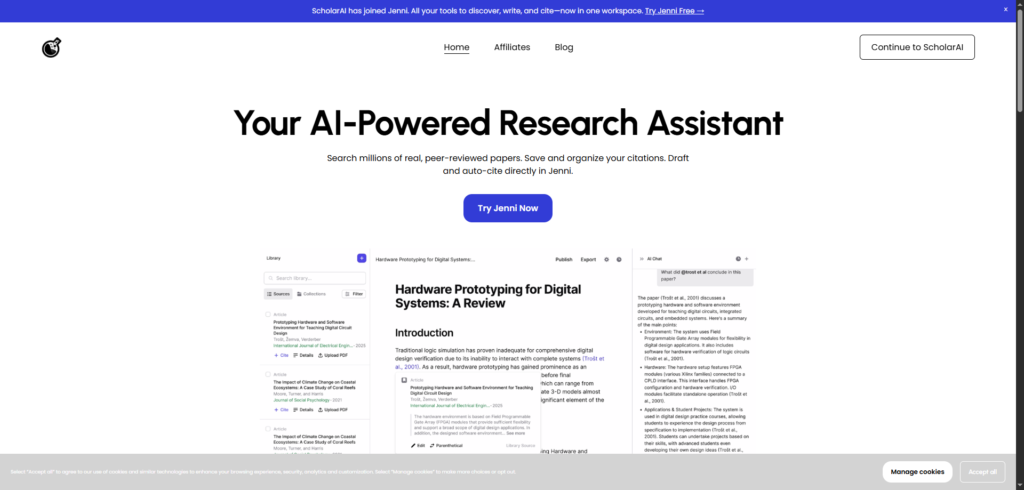
ScholarAI is an AI-powered research assistant designed to help users discover, analyze, organize, and understand academic literature more efficiently. The platform provides access to hundreds of millions of research papers, patents, and scholarly resources while offering AI-powered summarization, citation management, literature review support, and research assistance tools.
In this ScholarAI review, we’ll explore how the platform works, its key features, pricing, benefits, and whether it deserves a place in your research workflow in 2026.
Why Academic Research Is Becoming More Difficult
The modern research environment presents several challenges.
Researchers must often:
- Search multiple databases
- Read dozens of papers
- Compare conflicting findings
- Organise references
- Create literature reviews
- Generate citations
- Extract key insights from lengthy studies
Even experienced academics can spend days gathering the information needed to answer a single research question.
For students, the process can be even more overwhelming.
The rapid growth of scientific literature means that finding relevant information is often more difficult than analyzing it. As a result, many researchers are turning to AI-powered tools to help manage information overload and improve productivity.
What Is ScholarAI?
ScholarAI is an AI-powered research platform built specifically for academic and scientific workflows.
Unlike general-purpose AI chatbots, the platform focuses on scholarly information and research-related tasks.
Users can leverage ScholarAI to:
- Search academic papers
- Discover patents
- Summarise research
- Generate citations
- Analyse documents
- Create study guides
- Organise research notes
- Draft academic content
The platform integrates access to more than 200 million scholarly resources, including peer-reviewed publications, preprints, patents, and academic databases.
Its primary audience includes the following:
- Students
- Researchers
- Academics
- Scientists
- Healthcare professionals
- Graduate students
- PhD candidates
- Research teams
Rather than replacing researchers, the platform aims to accelerate research workflows and reduce repetitive tasks.
How ScholarAI Works
One of ScholarAI’s strengths is its ability to combine research discovery with AI-powered analysis.
Step 1: Search Research Sources
Users can search academic literature using natural language queries.
Rather than relying exclusively on keyword-based searches, the platform helps identify relevant studies, papers, and publications related to a specific topic.
Step 2: Analyse Research Papers
Once papers are identified, ScholarAI can help users understand the following:
- Research objectives
- Key findings
- Methodologies
- Conclusions
- Important insights
This reduces the amount of time required to review large volumes of literature.
Step 3: Generate Citations and Notes
Researchers can create citations and organize supporting materials directly within their workflow.
The platform supports thousands of citation styles and helps maintain consistent referencing standards.
Step 4: Create Research Outputs
Users can generate:
- Study guides
- Research summaries
- Literature review foundations
- Draft content
- Organised notes
This helps bridge the gap between research discovery and writing.
ScholarAI Review: Key Features
1. Access to 200 Million+ Research Sources
One of the platform’s most impressive capabilities is its access to a vast academic knowledge base.
Users can search across:
- Peer-reviewed journals
- Academic papers
- Research publications
- Patents
- Preprints
- Scientific databases
This centralized access simplifies the research process significantly.
2. AI Research Assistant
The platform includes an AI assistant specifically designed for research tasks.
Instead of manually reading dozens of documents, users can ask questions and receive contextual answers based on relevant research sources.
3. Paper Summarisation
Academic papers can often exceed dozens of pages.
ScholarAI helps users quickly understand complex studies by generating concise summaries that highlight key findings and conclusions.
4. Citation Generation
Proper referencing remains essential in academic writing.
The platform supports citation generation across more than 2,600 citation styles, helping students and researchers maintain consistency throughout their work.
5. PDF Analysis and Research Chat
Users can upload PDFs and interact with them using conversational prompts.
Rather than manually searching through lengthy documents, researchers can ask targeted questions and receive relevant answers.
6. Study Guide Creation
Students can convert research materials into the following:
- Study notes
- Revision guides
- Learning summaries
- Organised knowledge resources
This makes the platform useful beyond traditional research applications.
7. AI-Assisted Writing
The platform includes tools that help streamline academic writing, citation management, and content structuring.
Researchers can move from information gathering to drafting more efficiently.
Benefits of Using ScholarAI
Save Research Time
Researchers can identify and analyze relevant papers much faster than traditional manual workflows.
Improve Literature Reviews
The ability to discover, summarize, and organize research sources helps simplify literature review creation.
Reduce Information Overload
AI-powered analysis helps users focus on the most relevant findings rather than reading every paper in full.
Enhance Academic Productivity
Students and researchers can spend more time thinking critically about research rather than searching for it.
Support Better Knowledge Organisation
Integrated notes, citations, and document management create a more structured research environment.
Who Should Use ScholarAI?
University Students
Students working on essays, dissertations, and coursework can accelerate research and citation management.
Graduate Researchers
Master’s and PhD candidates conducting extensive literature reviews may find the platform particularly useful.
Academic Researchers
Researchers analyzing large volumes of literature can improve efficiency through AI-powered discovery and summarization.
Healthcare Professionals
Medical professionals staying current with scientific developments can benefit from streamlined access to research publications.
Research Teams
Collaborative teams can use the platform to organize information and accelerate research workflows.
ScholarAI Pricing
ScholarAI offers both free and premium options.
According to the platform’s pricing information:
Free Plan
- 5 one-time credits
- Limited uploads
- Basic research access
Basic Plan
- Approximately $9.99 per month
- Monthly credits
- Increased upload capacity
- Expanded research functionality
Premium Plan
- Approximately $18.99 per month
- More credits
- Advanced research capabilities
- Higher usage limits
Team Plans
- Custom pricing
- Collaboration spaces
- Shared data access
- Enterprise-level features
Pricing may change over time, so users should always verify the latest information on the official website before subscribing.
Pros and Cons
Pros
- Access to extensive academic databases
- AI-powered paper summarisation
- Citation generation support
- Research-focused design
- PDF analysis capabilities
- Study guide generation
- Helpful for literature reviews
- Free plan available
Cons
- Advanced features require paid plans
- AI summaries should still be verified against original papers
- Some sources may remain behind publisher paywalls
- Credit-based usage may not suit all researchers
Final Thoughts
ScholarAI has positioned itself as a specialized research assistant rather than a general AI chatbot.
Its focus on academic workflows, literature discovery, citation management, and paper analysis makes it particularly valuable for students, researchers, and professionals working with scholarly information. Instead of replacing traditional research methods, it helps users navigate increasingly large volumes of information more efficiently.
The combination of academic search, AI-powered analysis, citation tools, document interaction, and writing support creates a comprehensive research environment that can significantly reduce administrative workload.
For anyone regularly working with academic literature, ScholarAI is certainly worth considering.
Frequently Asked Questions (FAQ)
What is ScholarAI?
ScholarAI is an AI-powered research assistant that helps users search, analyze, summarize, and organize academic papers, patents, and scholarly resources.
Is ScholarAI free?
Yes. The platform offers a free plan with limited credits and research functionality. Premium plans provide additional capabilities and usage allowances.
Can ScholarAI generate citations?
Yes. The platform supports citation generation across thousands of citation styles, helping users maintain accurate references.
Who should use ScholarAI?
Students, researchers, academics, healthcare professionals, and research teams can all benefit from its research assistance capabilities.
Can ScholarAI analyze PDFs?
Yes. Users can upload documents and interact with them through AI-powered analysis and question-answering features.
Is ScholarAI worth it?
For users who regularly conduct literature reviews, analyze academic research, or manage large volumes of scholarly information, ScholarAI offers a practical combination of discovery, analysis, and productivity tools that can significantly streamline research workflows.